“Sleep is the best meditation” – Dalai Lama
It is around 3pm, and school is almost over. Drowsiness comes over me in full force, and no matter how hard I try I cannot seem to focus on the rules of Spanish grammar that are being painted in Expo on the whiteboard in front of me. On the bus ride home I am only half-way awake and by the time I get home all I want to do is lie down and sleep. This had become routine, so the first thing I have decided to tackle for this project is my sleep. How can someone possibly happy if they are struggling to stay awake throughout the day?
Optimizing sleep is not easy. It goes wrong very easily, but there are things that can be done. For me it started by changing when I wake up. For almost a year, I would wake up incredibly early (between 4 and 5am) to go train in the morning before school, but I don’t think this was the problem necessarily. It was more that one day I would wake up at 4:30, and the next 8am. Those large swings in wake up time are horrible for both sleep quantity and quality. So, what I do now is I wake up at 7am every single day. I allow myself around a half hour of variation on either side (so between 6:30am, and 7:30 am), but 90% of the time at it 7am exactly.
This has dictated when I go to bed. I feel best with between 8.5 and 9 hours of sleep, so that means my bedtime is between 10:00 and 10:30pm. This addresses the quantity of sleep I am getting, up next is quality.
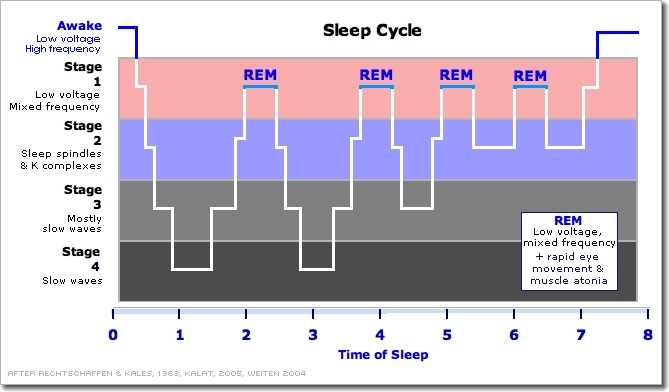
This shows the different stages of sleep throughout the night. Each sleep cycle takes an hour and a half on average.
In order to get good high quality sleep (which includes being able to fall asleep relatively fast, staying asleep, and reaching deep sleep), I have been doing a couple of things. First is limiting my use of electronics at night. I try to stop looking at any screens around a half hour before I want to be asleep, although this is somewhere where I can improve still. Electronics also no longer enter my bedroom. This is because the blue light emitted from screens stop the production of melatonin in the body, which is necessary to be able to sleep. Additionally, I attempted to make my bedroom is dark as possible, that was not a total success, so I currently wear a sleeping mask to block out any light.
Another essential is the monitoring of temperature. For most people the optimal temperature to sleep in is between 65 and 68 degrees Fahrenheit, so I do my best to make sure that my bedroom is around that temperature.
After I had done all these things, I was still encountering problems. I was waking up at least once, usually more like three or four times at night. That was no good. After doing some more reading and listening to podcasts, I came across eating large amounts of food before going to sleep as a potential cause for this. It causes a spike in blood sugar, and then once the blood sugar levels come back down, there is an increase in insulin. Insulin is a hormone released from the pancreas and it can actually make you somewhat hyper-alert, which can cause you to wake up. There are days where I eat dinner past 8:00 pm, and this is kind of unavoidable, so there needed to be something else I could do. In a podcast I listened to, Dr. Michael Breus (a sleep doctor) mentioned using raw honey and/or guava tea to stabilize blood sugar levels throughout the night and therefore avoid this whole ordeal. So far it has worked like a charm.

A simple diagram explaining the purpose of insulin.
All of this has been working incredibly well so far. I no longer feel tired throughout the day, and feel I have more energy to do the things I like to do. And that means I am happier as well.
I think what this has shown me is that self-experimentation is essential to learning anything. It is great to read, listen and watch, and get a bunch of information, but if you do not use it, none of that matters. Just trying things out and seeing what works for me has been the way to go so far.
That being said, reading has been important to this project so far. My main reading has been in “The Happiness Project” by Gretchen Rubin. She documents a year spent trying to be happier through all kinds of strategies. So I’m looking at what she has been doing and copying some of that for myself.
On top of that, I have started reading “Guide to Tipitaka” by U Ko Lay, which is a collection of Buddhist scripture and texts. I’ve always felt that Buddhist seem to be some of the most content and appreciative people, so it only makes sense to learn more about Buddhism to try and replicate some of the wisdoms portrayed in that text.
That has been my progress so far, with more to come.





 Practicing thankfulness and appreciating these simple aspects allows you to escape the trap of conformity. Personally, I like to take a few minutes per day to be quiet and silence my mind into an almost meditative state. This has helped me be more in tune with the appreciation of small things, which makes the bigger things more and more meaningful. I am thankful for the ability to pursue my passions and to have people in my life that support me and who allow me to be who I want to be. This allows me to be more present in life and makes other experiences more enriching. Appreciating these relations and this support keeps me motivated when otherwise I might have given up. Like Robert Holden says, “the real gift of gratitude is that the more grateful you are, the more present you become.”

